01 Patio Season · 1 of 3
Recommissioning a Wolf Grill After a Front Range Winter
The first warm Saturday in May is the worst time to find out what the winter did. A working order for bringing a Wolf outdoor grill back: supply, power, tubes, burn-off, and the two jobs that are not yours.
Written by Denver
Carys Pemberton
- Role
- Cooking-appliance technician — burners and gas pressure
- In the trade
- 20 years in the trade
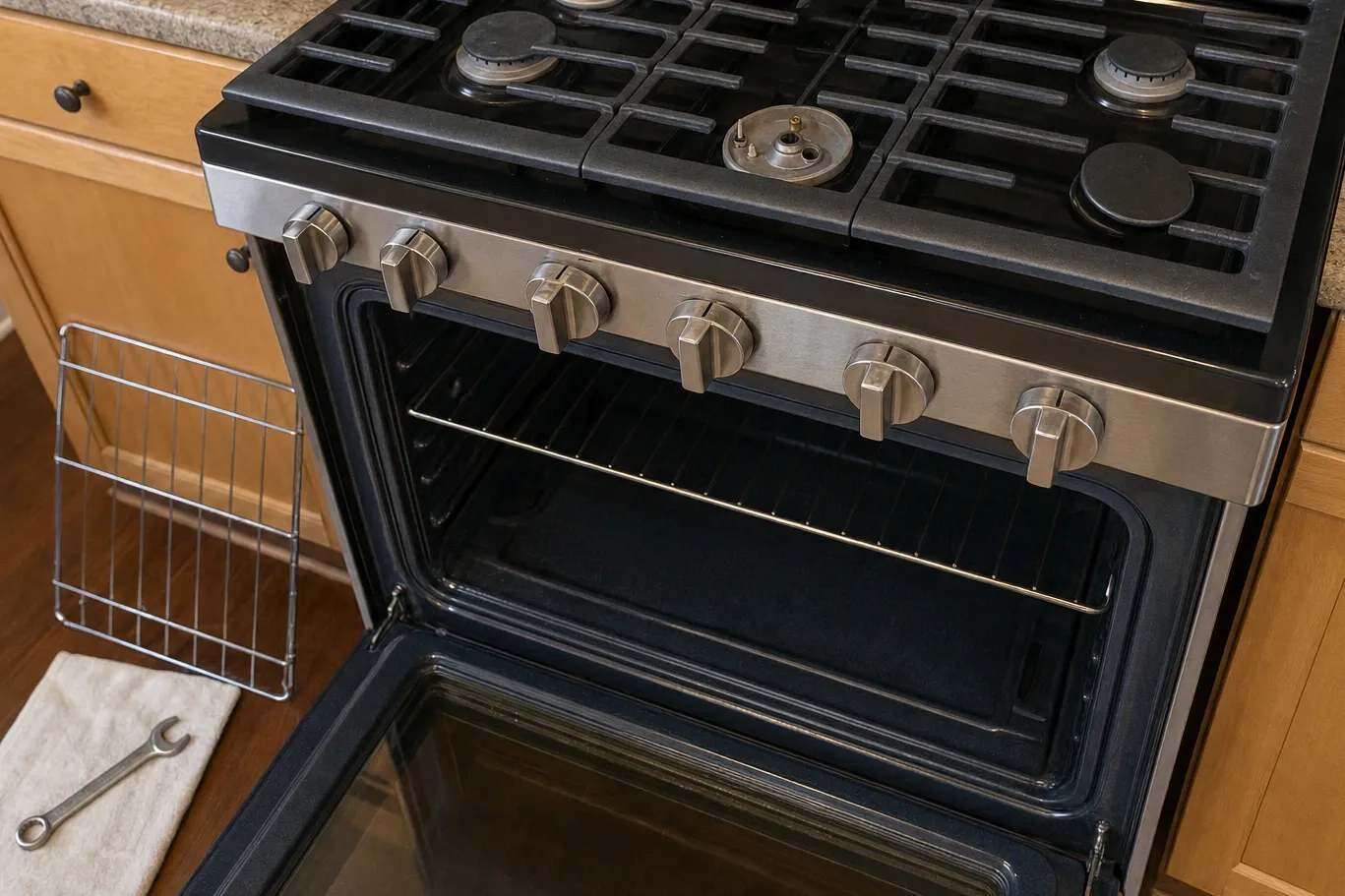
There is a particular Saturday in May on the Front Range. The weather turns, the cover comes off, somebody pushes a knob in — and nothing happens. The grill has not broken over the winter. It has simply been left in the one place on the property where nothing is maintained, through five months of freezing at night and thawing in the afternoon, and it wants bringing back in a particular order.
That order is below. None of it is complicated and most of it is free. What it does is separate the things you can settle in twenty minutes from the two that are genuinely not an owner’s job, so that if you do end up calling somebody, you call them about the right thing.
Start with the supply, not the knob
The first question is whether gas can reach the grill at all, and the second is whether electricity can.
Wolf puts an approved external shut-off valve in the supply line near the grill, somewhere accessible, and a lot of people close it in autumn — sensibly. A valve handle lying in line with the pipe is open; across it is shut. If yours is a propane grill, the cylinder is the equivalent question, and it is more often the answer than people expect: Wolf’s own instruction is to disconnect the cylinder whenever the grill is not in use, so after a winter in the shed it is frequently just not back on.
Then the power. These grills light on hot-surface igniters, not sparks, and that takes a grounded 120-volt supply on its own circuit through a GFCI receptacle. A GFCI that tripped in a February storm with nobody out there to see it is one of the most common reasons a grill appears completely dead in spring: no glow, no interior lights, no knob lights. All three go together because they are all on the same circuit, and that pattern is itself the diagnosis.
Then look inside the burner tubes
This is the step people skip, and it is the one Wolf prints a warning about rather than a tip: spiders and insects nest inside grill burners, and the guide says plainly that it is a fire hazard as well as a heat problem. A burner tube is dark, dry, sheltered and warm in the afternoon — it is the best address in the garden between October and April.
A torch down each tube tells you most of what you need. Webbing, a nest, or anything that is not metal means the burner is not going to light properly and should not be persuaded to. Clearing what is visible from the outside is fine. Taking the burners out is where it stops being an owner job, because they have to go back with every orifice sitting inside its air shutter, and Wolf is explicit that a burner assembled any other way can let gas escape outside the burner.
Light it the way the guide says
With the supply on, the power confirmed and the tubes clear, the lighting procedure itself is worth following exactly.
Open the hood completely — never with the cover on, and never with the hood down. Open the shut-off valve. Push the burner knob in and watch for the igniter to glow under the grates, inside the flash tube, before turning anything. Once it is glowing, push in and turn the knob anticlockwise to HI and hold it for five seconds. If a flame has not appeared in those five seconds, turn that knob off, wait five minutes, and start again. The five-minute wait is not superstition: it is there so that unburnt gas can clear before another ignition attempt.
If there is no power at all and you need the grill working tonight, Wolf does describe manual lighting — the same first steps, then a long lighter in through the grates near the top of the flash tube, with face and body kept well away. It is a way to cook dinner, not a repair.
Burn it off, then clean it cold
Once it lights, the first proper run is a burn-off. Every burner on HI, including the sear burner but not the rotisserie burner, hood closed, ten to twelve minutes. That carbonises what is left on the briquettes and the interior and makes the rest of the cleaning possible.
After that it has to cool completely before anything is touched. The grates get scrubbed while they are still hot, with a brush and water — the steam does most of the work — and everything else waits. The drip tray is the one with consequences: Wolf asks for it after every use, because a loaded tray is what turns a fat flare into a grease fire.
Two things not to do. Nothing wet goes near the infrared sear burner; its ceramic face does not forgive it, and a briquette tray must never sit over it. And no steel wool on the stainless, ever — a mild abrasive pad with stainless cleaner, worked along the grain, is as aggressive as it should get.
What is left after all that
If the grill lights, holds a flame across the whole burner and comes up to temperature on a full preheat, the winter did nothing and the season can start.
If it lights but stays short of heat, or one burner behaves differently from the others, or the sear zone never goes red, the next question is the supply under load — and that means a manometer at the inlet, read against the figures Wolf publishes for your fuel, rather than a guess. That is the point at which this stops being a checklist and starts being a visit.
Wolf Repair Denver Pros does grill recommissioning across this sector, on (720) 702-9054, and the flat service call covers the trip and the whole diagnosis before anything is quoted.
Follow-ups
- How long does bringing a grill back take if nothing is wrong?
- An hour, most of it waiting. The burn-off alone is ten to twelve minutes with every burner on high and the hood down, and the grill has to cool again before the briquette trays and the drip tray can be cleaned. The looking-at parts are quick; the standing-about parts are not.
- Should the cover come off before the first light?
- Always, and the hood with it. Wolf puts this in the safety instructions rather than the tips: never light an outdoor grill with the cover in place, and open the hood completely before the knob is touched. Gas collecting under a closed hood is the reason both of those sentences exist.
- Is there anything on this list I should not do myself?
- Two things. Taking burners out to clear them properly, because they have to go back with each orifice inside its air shutter or gas can leave the burner where it should not. And anything on the supply line. Wolf Repair Denver Pros does both on (720) 702-9054.
- What if it lights but never gets properly hot?
- Give it the full ten-minute preheat with the hood down before judging it, which is what Wolf asks for. If it is still short after that, the usual causes are the supply under load, a partially blocked burner, or wind stripping the heat off an exposed patio faster than the burners can replace it.
All of Patio Season 01 / 03