02 Patio Season · 2 of 3
Natural Gas or Propane for a Wolf Grill at Denver Altitude
A Wolf grill is built for one fuel and the rating plate says which. What actually differs between a natural-gas grill and a propane one on a Denver patio, what Wolf will and will not let you change, and which symptoms belong to the fuel rather than the grill.
Written by Denver
Carys Pemberton
- Role
- Cooking-appliance technician — burners and gas pressure
- In the trade
- 20 years in the trade
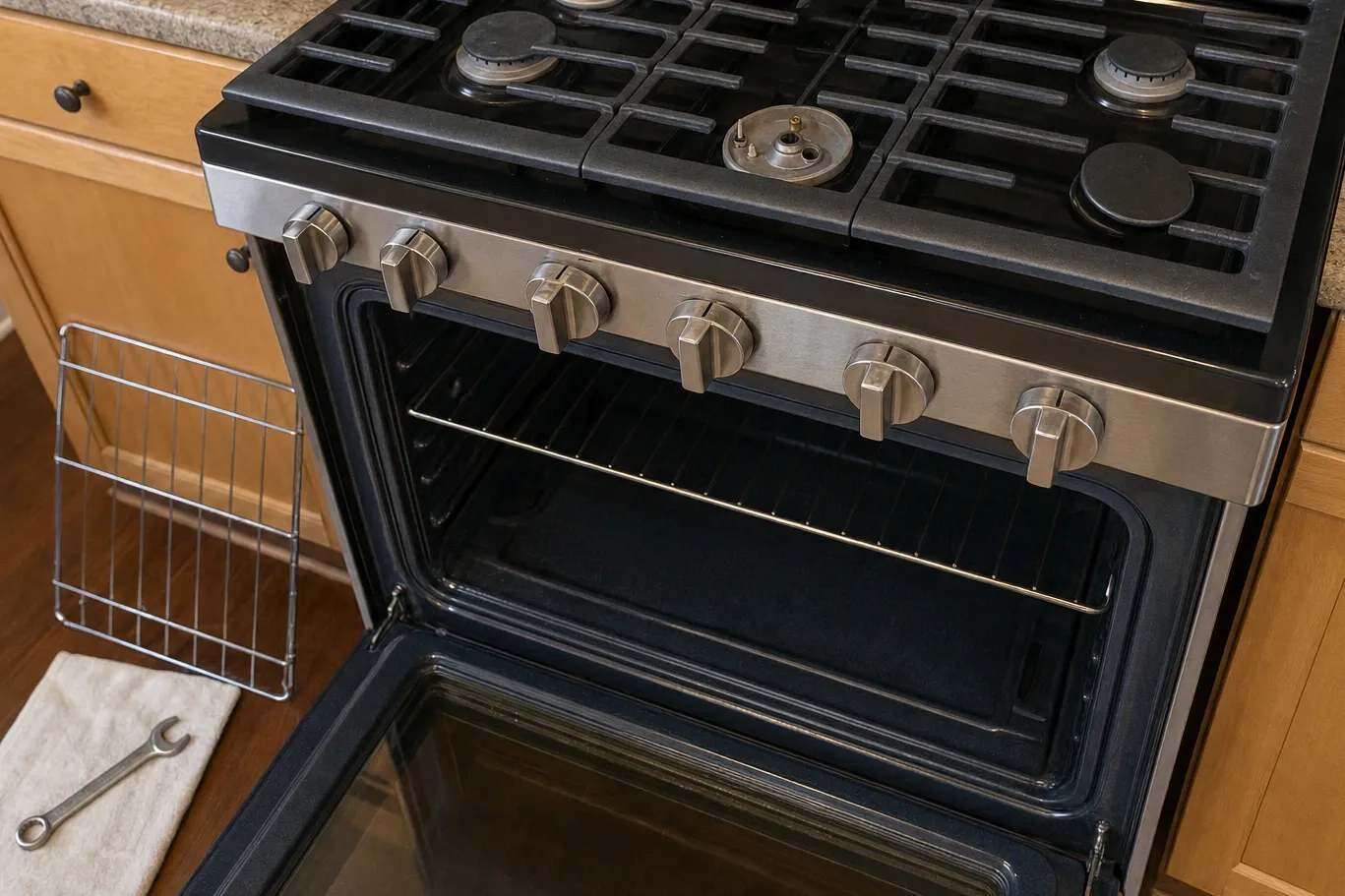
Every outdoor grill on a Denver patio runs on one of two fuels, and the householder almost never chose which. It was settled when the grill was built, and it is recorded on a plate you have to pull the drip tray out to read.
That matters more than it sounds. A good share of the complaints that arrive in the first warm week are not faults at all. They are one fuel behaving the way that fuel behaves on a cold, open, mile-high patio, being read as a burner going bad.
What the rating plate has already decided
Wolf manufactures its outdoor grills and burner modules for natural gas or for LP, and the product rating plate carries the type for that specific model. On a grill the plate sits above the drip tray behind the logo, which is why the tray comes out before anybody can read it; on a burner module it is underneath the control panel, over on the right-hand side.
If the plate and the house disagree, Wolf’s own instruction is to stop there and speak to the dealer, or to check what gas is actually available with the local supplier. Neither the use and care guide nor the installation guide sets out a procedure for moving one of these grills from one fuel to the other. This guide will not invent one, and neither should anyone offering to do it in an afternoon.
What the two supplies do differently under load
Wolf publishes what it expects to see at the appliance. A natural-gas grill wants five inches of water column with the burners running, on a line carrying at least seven. An LP grill wants ten inches at the appliance and eleven on the line. Both sit behind a regulator that must never hand over more than fourteen. Those are pressures rather than volumes, and the reading that matters is taken with the grill working, not standing idle. That distinction is the whole reason a grill can light beautifully and still disappoint an hour later.
A house line is the steadier of the two. When it lets go, it usually lets go under load: every burner lit, the sear zone drawing as well, and the pressure sagging where only a gauge would show it.
A cylinder is a different animal. Propane leaves it as vapour boiled off the liquid beneath, and liquid boils less willingly as it cools and as the level drops. On the Front Range the warmth goes out of a garden quickly once the sun is off it, and the cylinder standing beside the cart goes with it. A grill that seared at seven and sulks at nine has rarely developed a fault in two hours.
Altitude deserves one plain sentence, because up here it gets blamed for everything. Neither Wolf document describes a high-altitude setting, a different orifice or any derating for these outdoor grills. What is genuinely different outdoors at this elevation is the air around the food: thinner, cooler after dark, and usually moving. That works on the cooking, not on the gas train.
Which symptoms belong to the fuel
Fading through an evening on propane, and fading worse the colder it gets, is the cylinder until proved otherwise. Two questions settle most of it: how much is in there, and how cold it has become.
A hard first light after a cylinder has been reconnected, or after a winter with the supply shut off, is usually air in the line rather than gas missing from it. Wolf’s troubleshooting says exactly that: purge the trapped air, then follow the lighting sequence properly. Five seconds with the knob held in, and if nothing catches, knob off, five minutes, begin again.
A flame that lifts and dies belongs to neither fuel. Wolf’s answer to that one is a wind block, and on an exposed patio in this part of town the wind block is frequently the entire repair.
Nothing glowing at all belongs to neither fuel either. These grills light on hot-surface igniters that need mains power on a circuit of their own through a GFCI receptacle, so no glow, no interior lamps and no knob lights is one symptom with one likely cause, whatever is in the pipe.
And one burner behaving differently from its neighbours is never the fuel. The same supply reaches all of them. The difference is downstream of that, in a port, a tube or an air shutter.
What the fuel decides about where the grill lives
Both fuels arrive through a regulated supply, and both want an approved external shut-off valve near the grill, somewhere a person can actually get at it. Wolf is explicit that access to that valve must not be blocked, which is worth remembering before the cabinetry goes in around a built-in.
Wolf specifies a three-quarter inch inside diameter line to the appliance, and where local codes permit it, a certified flexible metal connector three feet long, half or three-quarter inch bore, onto the half-inch female inlet on the unit. On LP there are two instructions that get forgotten in a garden: the cylinder is disconnected when the grill is not in use, and it is never filled beyond eighty per cent.
Siting is a fuel question too. Wolf asks you to weigh three things when choosing the spot, exposure to wind, how close it is to the way people walk, and the length of the gas run. A corner that solves the first often lengthens the third.
The pipework itself is a gas fitter’s job, and Wolf asks that the installation be done by a qualified installer, a service agency or the gas supplier. What happens after the inlet, pressure under load, ignition, the burners, the sear zone, is ours. Wolf Repair Denver Pros works on both fuels across this sector: (720) 702-9054.
Follow-ups
- How do I tell whether my grill is set for natural gas or propane?
- By the rating plate, not by the hose. On a Wolf grill it sits above the drip tray behind the logo, so the tray has to slide out to read it. The plate names the gas that model was built for, and it outranks whatever a previous owner connected it to.
- Can a Wolf outdoor grill be converted from propane to natural gas?
- Not on our word. The use and care guide and the installation guide stop at the same instruction: if the appliance does not correspond to the gas you have, contact the dealer. No conversion procedure is published for these grills, so nobody should be selling you one over the phone.
- Does Denver altitude mean a grill needs different jets?
- Nothing in Wolf's outdoor documentation says so. There is no high-altitude orifice, setting or derate published for these grills, and we do not fit one. What altitude and an open garden really change is the air around the food, which is why a full preheat and a wind block do more here than parts.
- The grill fades late in the evening. Is that the fuel or the grill?
- On propane, start with the cylinder: how much is left in it and how cold it has become since sunset. On a house line the same complaint points at pressure under load instead, which needs a gauge at the inlet. Wolf Repair Denver Pros measures both on (720) 702-9054.