03 Mile-High Gas · 3 of 4
Wolf oven never reaches temperature — altitude, or a real fault?
Denver gets blamed for a lot of bad baking. Here is how to tell a genuine Wolf oven calibration fault from the altitude, what a probe on the rack proves, and which part is usually behind a cavity that runs cold.
Written by Denver
Carys Pemberton
- Role
- Cooking-appliance technician — burners and gas pressure
- In the trade
- 20 years in the trade
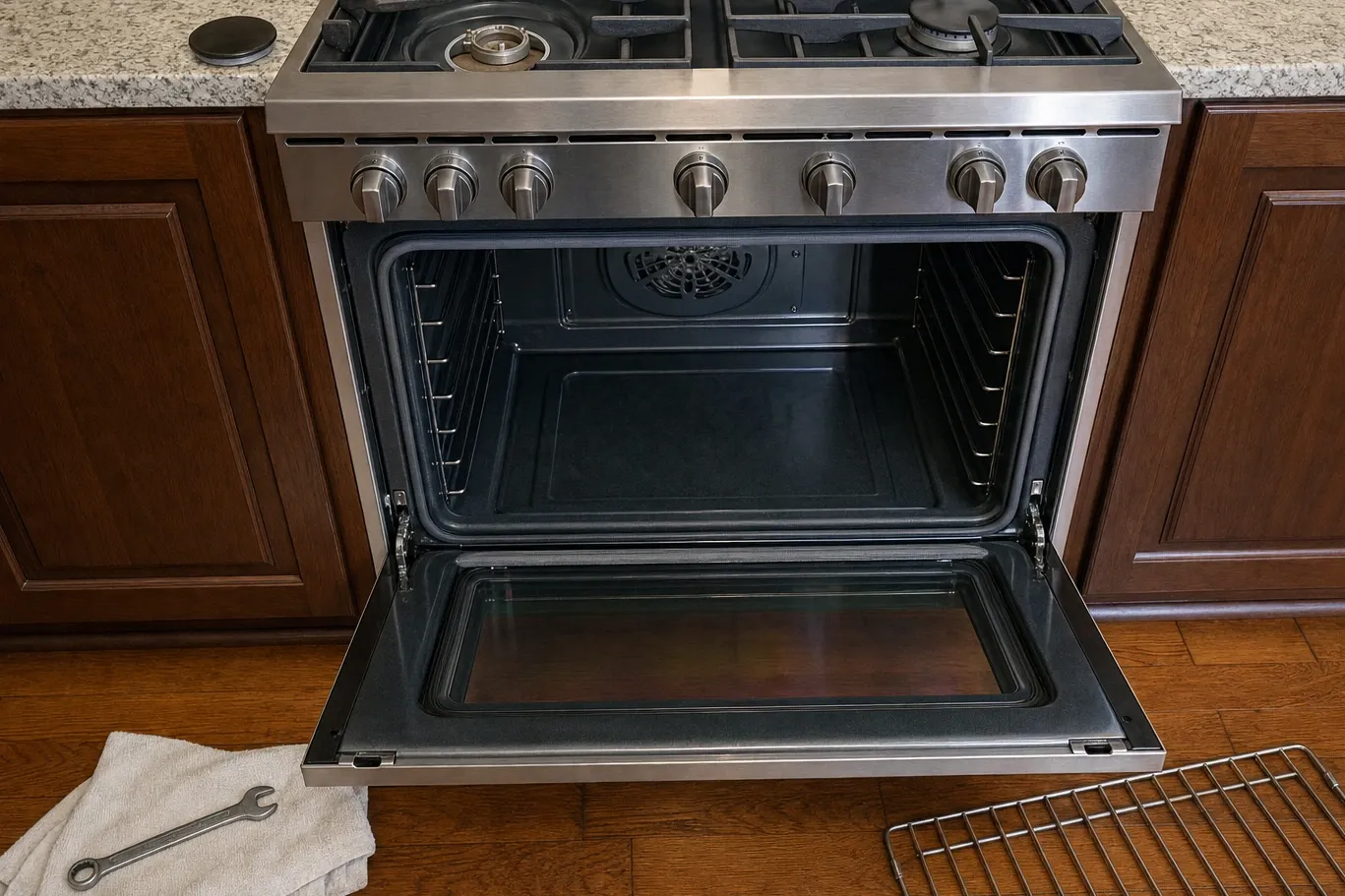
Every Denver kitchen has the same conversation about its oven eventually. Something that used to come out right does not any more, the recipe gets blamed, then the altitude gets blamed, and two years later it turns out the cavity has been running 30°F under set point the whole time. Altitude is real. It is also the most convenient excuse an ageing oven has ever had.
What altitude does, and what it does not
At 5,280 feet the air is thinner and the pressure is lower. Water boils at around 202°F instead of 212°F, gas expands faster in a batter, and leavening runs away with itself before the structure sets. That is why Denver recipes cut the baking powder, add a little liquid and often go up 15 to 25 degrees on the dial.
Notice what is in that list and what is not. Altitude changes what your food does at a given temperature. It does not change the temperature your oven holds. An oven set to 350°F should sit near 350°F in Denver exactly as it does in Miami. If yours does not, that is a fault, and it is measurable.
Proving it with a probe, not a guess
The instrument that settles this is a thermocouple probe on the middle rack, logged through a full cycle from cold — not an oven thermometer read once through the door glass, and definitely not the oven’s own display, which is the thing under suspicion.
What the trace tells you:
- Runs low and steady, tracking about 20 to 40 degrees under. Sensor drift or a calibration offset somebody set years ago and forgot.
- Climbs slowly and never arrives. Heating capacity: a failing element, or on a gas cavity a burner that is not getting full gas or full air.
- Reaches temperature, then swings 50 degrees or more. Sensor position, a loose sensor connection, or a convection fan that has stopped moving air.
- Right in the middle, wrong at the edges. Airflow — fan, shroud or a door that is no longer sealing square.
Half an hour of logging replaces an afternoon of parts-swapping, which is why it happens before anything gets ordered.
The parts behind a cold cavity
The temperature sensor. Wolf ovens use an RTD sensor, and the number to know is that it sits near 1,080 ohms at room temperature. Read it cold, then read it hot: a sensor that is accurate cold and lying at 400°F is still a failed sensor. This is the single most common answer for an oven that bakes consistently low.
The bake element, or the burner and its igniter. On an electric cavity a blistered or split element still heats — just not to rating — so the oven creeps up and stalls short. On a gas cavity the classic is a glow-bar igniter that lights up convincingly but no longer draws enough current to open the safety valve reliably, giving you long stretches with no heat at all. Both are measured, not guessed.
The thermal fuse. Behind the back panel, and it opens after an overheat. Once it goes, that circuit is dead until it is replaced — and finding out what overheated matters as much as replacing the fuse.
The door. Slack hinge springs let the door sit a millimetre or two out of square, the gasket stops sealing at one corner, and the cavity loses heat as fast as it makes it. You can usually feel this one: a warm patch on the cabinet face beside the door, or a door that needs a shove to latch.
The control board. Last, and only when the measurements point there. Boards get sold for sensor faults constantly. Ask which reading condemned it.
What is worth doing yourself first
Take everything out of the oven and look at the element or, on a gas cavity, the burner tube on the floor of the oven. Blistering, splits and a pale patch near a terminal are all visible with a torch and no tools.
Close the door on a strip of paper at each corner and pull. If it slides out freely at one corner and grips at the other three, the door is your first suspect.
Check whether the fault is the whole oven or one function. Bake fine but broil dead, or vice versa, narrows it to one element or one relay before anyone arrives.
And write down what you actually observe: set point, what the display says, what your own thermometer says, and how long it took. That note is worth more on the phone than any description of the food.
When to stop and book it
Sensors, elements, igniters, fuses and hinge springs all sit behind fixed panels with mains voltage or a live gas connection on the other side. A wall oven also has to come out of its cabinet to be worked on properly, and going back in without marking the cabinetry is its own skill.
The honest test is this: if you have logged a cavity that runs cold, checked the door and looked at the element, you have done everything worth doing without a meter. What is left is measurement and access — and on a Wolf oven that is worth paying somebody to do once, properly, rather than buying parts to see which one was it.
Follow-ups
- How far off set point does a cavity have to be before it is worth fixing?
- A cavity cycling within about 10°F of the number on the dial is normal, and every oven does it. Consistently 25°F or more under, or a swing of 40°F or more between the top and the bottom of a cycle, shows up in anything with eggs or sugar in it and deserves proper measurement.
- Can I just turn the calibration offset up and live with it?
- You can, and it is the right answer when the sensor is accurate and you simply prefer a hotter oven. It is the wrong answer when the sensor has drifted, because you are then correcting one error with another and the oven will still swing. Offsets also do nothing for an element or burner that is failing under load.
- Is high-altitude baking really a thing?
- Yes. Lower air pressure means liquids boil cooler, leaveners expand faster and batters set later, which is why Denver recipes cut baking powder and add liquid. None of that changes the temperature your oven holds — which is exactly why a real fault hides behind it for years.
- My steam oven throws a fill error instead. Same thing?
- No. That is a water path fault — supply, inlet valve, screen or a kinked line behind the cabinet, and often it has been marginal from the day it was installed. It is usually a quick fix, but it is a different diagnosis from a cavity that will not hold heat.